Podcast: Play in new window | Download (Duration: 56:30 — 38.8MB) | Embed
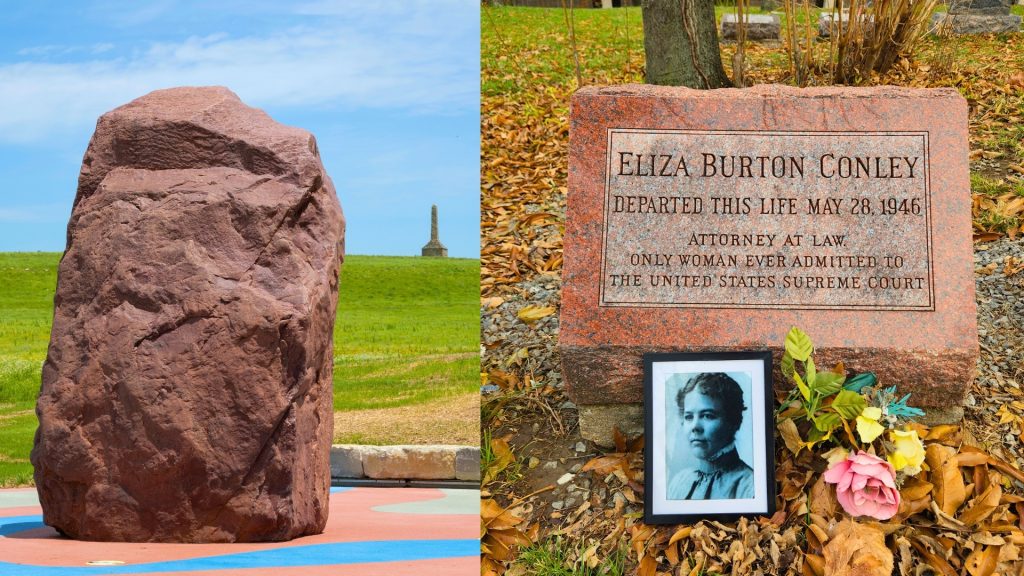
Eliza “Lyda” Conley was a strong, independent Wyandot woman who is credited with preserving the cemetery where her family and other tribal members were buried in the face of mounting commercial development pressure. Conley defended the Huron Indian Cemetery in Kansas City, Kansas in the courts as well as from a makeshift shack where she and her sister took up residence with their father’s Civil War shotgun around the turn of the last century. In the process, she became the first Native woman to argue a case before the U.S. Supreme Court. Her story, and that of Wyandot removal, is told in the book, “Lyda Conley and the Fight to Preserve Huron Indian Cemetery”, and in a new art installation at the Wyandotte County Historical Museum.
Also in Kansas, a 10-foot tall, 28-ton sacred boulder is now on Kaw Nation land after a multi-year struggle. Kaw citizens revered the rock for centuries. Then Lawrence officials commandeered it 1929 for a monument to the non-Native city founders. That started the fight by the Kaw Nation — the state’s namesake tribe — to repatriate it to tribal control. The history of Iⁿ’zhúje’waxóbe is documented in a book, “Shokhí: A Kanza Relative, a Monument, and Rematriation”, and gives readers a glimpse into the politics and human influences along the way.
GUESTS
c. huffman (Kaw), dis/abled poet and theologian
Dr. Tai Edwards, director of the Kansas Studies Institute and professor of history at Johnson County Community College
Justine Smith (Wyandotte), film and multimedia instillation artist and part of the Omakyehstih Collective
Madeline Easley (Wyandotte), writer, artist, and cultural organizer
Break 1 Music: Totah (song) The Delbert Anderson Trio (artist) MANITOU (album)
Break 2 Music: Mountain by the Sea (song) Various Artists (artist) Traditional Voices: Historic Recordings of Traditional Native American Music (album)
