
Washington State awarded a number of tribes almost $18 million for clean energy projects—from solar installations to electric fishing and research boat conversions. It is one of the alternative funding sources as tribes and tribal economic development ventures scramble to fill a void following the withdrawal of some $1.5 billion in federal dollars. We’ll get an update on where clean energy infrastructure and development trends are headed in the absence of any new federal money.
Past Shows
Tuesday, March 17, 2026 – Re-enactors help bring Native American perspective of the Revolutionary War to life
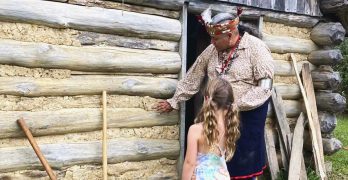
The American Revolution succeeded in making the 13 colonies independent from Britain, but for Native Americans, the war resulted in displacement from their homelands and an expansion of American encroachment. As the country gears up for the 250th anniversary of the U.S. declaring its independence, Native reenactors and historians are working to bring Native peoples’ involvement in key moments of this time in history to life. Their work spans events from the Siege of Boston to the divisions the war spurred within the Haudenosaunee Confederacy. We’ll hear from Native historians about the effort to better portray the time of the American Revolution with accuracy and authenticity.
GUESTS
DJ Huff (Seneca), historian
Matthew Putnam (Stockbridge-Munsee Community), president of the Stockbridge-Munsee Community cultural committee and tribal historian
Leon Sam Briggs (Tonawanda Seneca), historical reproduction specialist and traditional teacher
Monday, March 16, 2026 – What’s in a (tribe’s) name?
The words “Sioux”, “Chippewa”, and “Crow” are some of the well-known names in the official lexicon that identify tribes, but they are also among the monikers that arise from mispronunciations, errant assumptions, and even derogatory terms by outsiders that found their way into conventional use. Over the years, some tribes have undertaken the arduous process to change their official names to take back what they have always called themselves. Others simply change how they present their names to the public, without updating the official record. We’ll talk with representatives from tribes who seek to have their names better reflect their own culture and language.
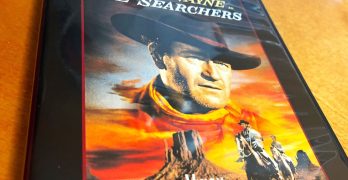
Friday, March 13, 2026 – The Searchers: cinematic treasure or stereotypical disaster?
John Ford’s 1956 film, “The Searchers”, is often lauded as a masterpiece. It follows Ethan Edwards (John Wayne) as an unapologetically racist ex-Confederate soldier on an obsessive odyssey to find his niece who was kidnapped by Comanches. The question of what he does when he finds her is a central tension of the plot. It was one of the first films added to the National Film Registry and ranks among the greatest films of all time by the American Film Institute. But its harmful stereotypes and other obvious drawbacks make it difficult watching for modern, informed audiences. As it marks 70 years since its release, we’ll hear from Native filmmakers and others about the place “The Searchers“ holds in film history.
We’ll also hear from Nuxalk filmmaker Banchi Hanuse about her documentary film, “Ceremony“, that premieres this week at South by Southwest. The documentary examines the cultural role of ooligan fish in Hanuse’s community in Bella Coola, British Columbia, Canada.
GUESTS
Sunrise Tippeconnie (Commanche, Navajo, and Cherokee), director of programming at deadCenter Film and co-host of the “Reel Indigenous” podcast
Julianna Brannum (Comanche), documentary filmmaker
Zacharias Kunuk (Inuit), filmmaker
Banchi Hanuse (Nuxalk), filmmaker, co-founder of Nuxalk Radio, and director of “Ceremony”
Thursday, March 12, 2026 – Confronting a past of forced sterilization
New Mexico is taking on an investigation into the sterilization of Native American women through coercion, deception, or by merely carrying out procedures entirely without consent. The state is mainly looking at time in the 1970s following the establishment of the federal Office of Population Affairs and a policy change that increased reimbursements for outside doctors contracting with Indian Health Service (IHS) facilities for each procedure. Native Americans were included in groups targeted for sterilizations because of the false impression they were less intelligent and that they were not as productive members of society as other groups. In 10 years, Native American birth rates were more than halved. Other states and Canada have broached the topic of forced sterilization that tried to formalize racist policies in the name of public health. New Mexico is the first to take aim at the role IHS clinics played in carrying out the policies.
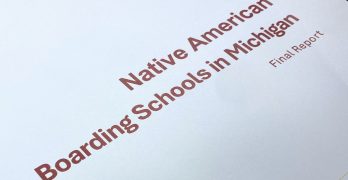
Wednesday, March 11, 2026 – Michigan backs away from Boarding Schools report
A 300-page report details the history and ongoing implications of Michigan’s role in the Indian Boarding School era. It includes dozens of interviews, public records, and a list of recommendations for state officials going forward. It details troubling accounts that have become familiar in the discussion about boarding schools — physical and sexual abuse of Native American students, oppressive methods to enforce assimilation, and limited accountability for anyone involved. But the state’s Department of Civil Rights is backing away from the report. After investing almost $1 million, the state is declining to release the final document to the public. It has since been posted online by the news site Bridge Michigan. We’ll talk to those involved about what is in the report and what it means that the state is not backing it.
We’ll also get perspective on the appointment of U.S. Sen. Markwayne Mullin (Cherokee/R-OK) as the Secretary of Homeland Security. We’ll hear from people who know and are familiar with his work as a longtime elected leader in Oklahoma.

NAC @ Santa Fe Indian Market
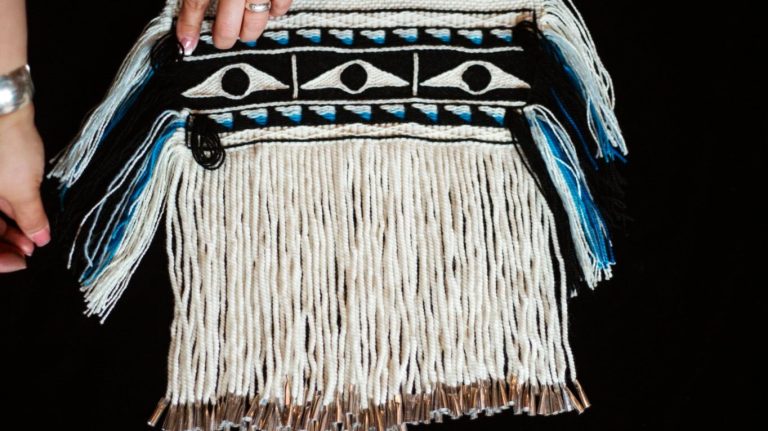
After 103 years, the Santa Fe Indian Market remains the biggest draw for Native artists, potters, and jewelry makers as well as those who appreciate and collect their work. More than 1.000 juried participants come from hundreds of Native communities, offering a hugely diverse range of inspiring work. We’ll take a small sample of that creativity and check in on the outlook for Native arts and arts education.
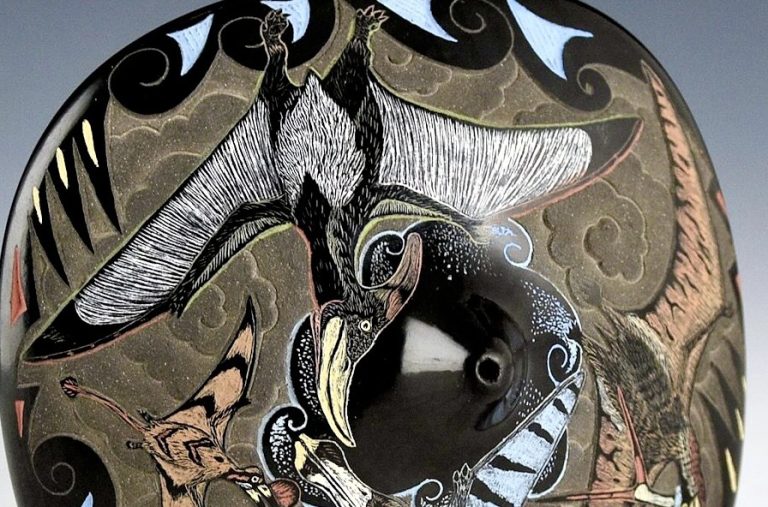
Distinctly Native American artwork, fashion, and films converge again for the annual Santa Fe Indian Market, with at least 1,000 booths and somewhere around 100,000 visitors. Native America Calling is live from Santa Fe, hearing from Southwestern Association for Indian Arts representatives, 2023 Best In Show winner Jennifer Tafoya, curators from the Native Cinema Showcase, and others to get a preview of the largest juried Native art market in the world.
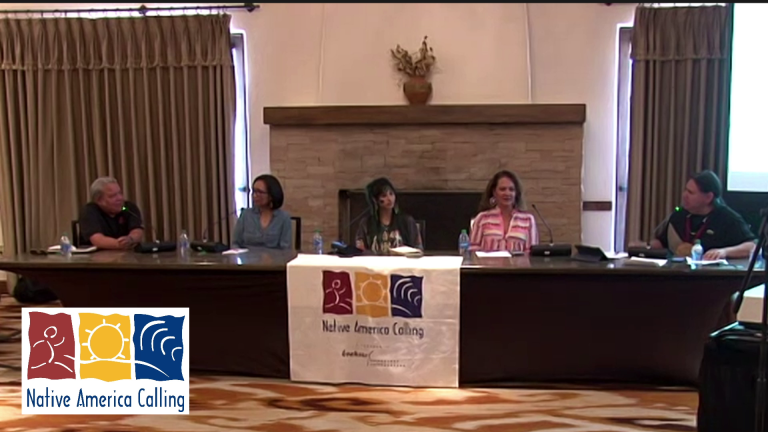
Listen back to Native America Calling’s live broadcast from the Santa Fe Indian Market featuring host Shawn Spruce and guests Dawn Houle (Chippewa Cree from Rocky Boy Montana), Mandolin Rain Song (Taos Pueblo), Jennifer Johns (Diné), and Jason Garcia (Santa Clara Pueblo).
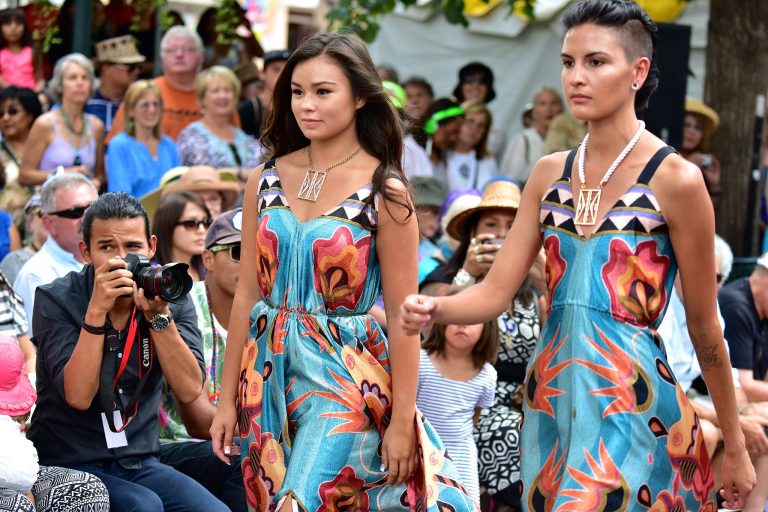
Artists from hundreds of Native nations are tending to their booths in the streets of Santa Fe, selling works they’ve labored for months to prepare. SWAIA’s Santa Fe Indian Market has come a long way in 100 years. Today on Native America Calling, Shawn Spruce is live from Indian Market for a second day with Dr. Suzanne Newman Fricke, director of Gallery Hózhó at Hotel Chaco; Dr. Robert Martin (Cherokee), Institute of American Indian Arts president, to get a feel for what’s in store for the next century; Amber Dawn Bear Robe (Siksika Nation), Indigenous Fashion Show producer for the Southwestern Association for Indian Arts and art history professor at the Institute for American Indian Arts; Dr. Jessica Metcalfe (Turtle Mountain Chippewa), owner of Beyond Buckskin; and Kristin Gentry (Choctaw), artist, photographer, writer, and curator.
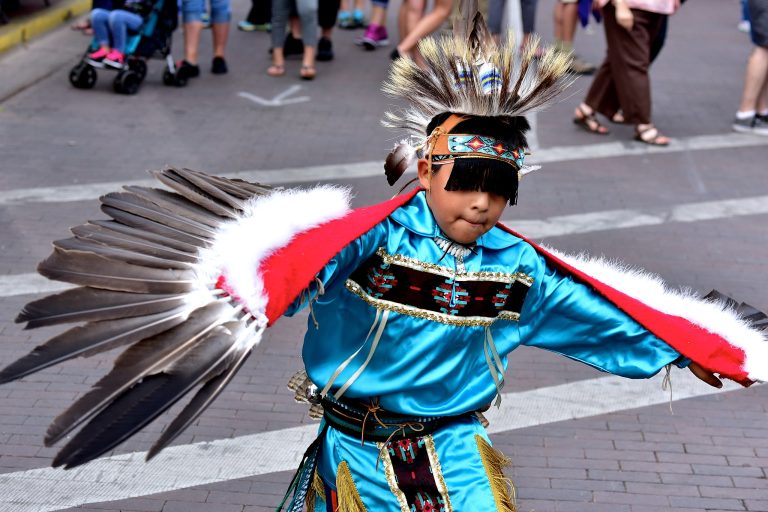
It survived the Termination Era, The Depression, a World War, and, most recently, a pandemic. The Southwestern Association for Indian Arts marks the 100th Santa Fe Indian Market, a place to buy works directly from artists, to experience the creative vision of Native designers, and watch films by Indigenous filmmakers.
Today on Native America Calling, Shawn Spruce is live from the Market to get a rundown of this year’s schedule and reflect on the evolution of this major achievement of Native creativity and commerce with Cindy Benitez, program manager for the Native Cinema Showcase by the National Museum of the American Indian; film director Fritz Bitsoie (Diné);Stephine Poston (Pueblo of Sandia), board chair for the Southwestern Association for Indian Arts; and Leah Salgado (Pascua Yaqui), Chief Impact Officer for Illuminative.
